

In our experience, within 90 days of closing, most PE-backed companies hire someone to audit marketing, whether that’s a fractional CMO, a consultancy, or an agency. Almost every one of those audits makes the same mistake: it catalogs what marketing is doing without asking whether the marketing function can actually drive the growth the board expects.
A post-acquisition marketing audit evaluates whether a portfolio company’s marketing function can produce the pipeline growth the board’s financial model requires. It works backward from revenue targets to assess positioning, demand generation infrastructure, content effectiveness, sales-marketing alignment, and attribution, rather than grading individual channels or tools in isolation.
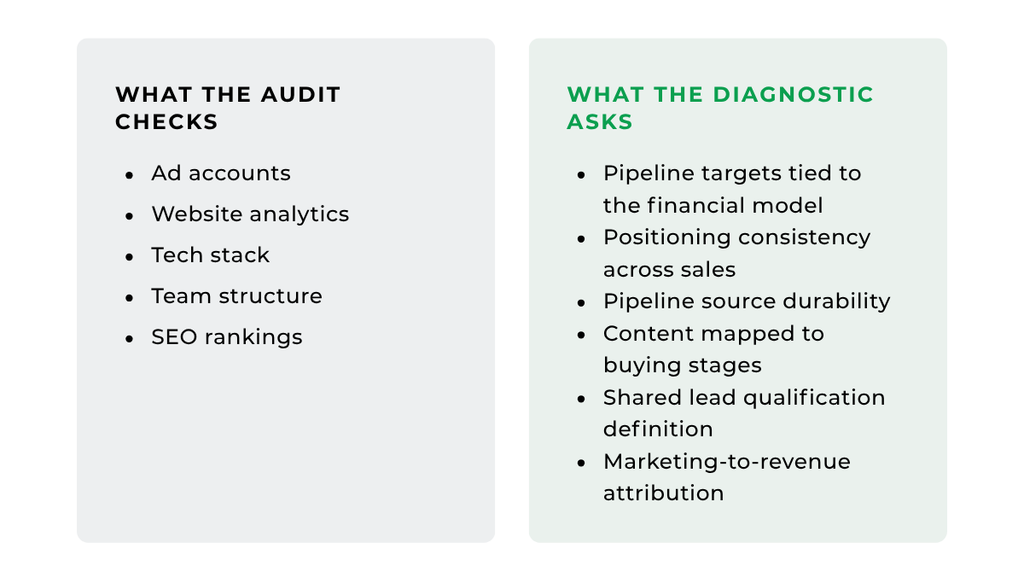
The audit follows a predictable pattern of inventorying the ad accounts, pulling the website analytics, assessing the tech stack, reviewing the team structure, and benchmarking the SEO. Six weeks later, a deck lands on the operating partner’s desk recommending more investment in whatever the auditor happens to specialize in. This is how the incentive works: the auditor’s revenue depends on the recommendation, so the audit is structured to arrive at it. Nobody hired to sell you paid media is going to come back and tell you the problem is your positioning. The spend is approved, marketing costs are up, and the dashboard has more charts than it used to. But pipeline contribution hasn’t moved. At all. Everyone points at “sales follow-through” or “brand awareness takes time” as the reason. The root cause is almost always the same: nobody worked backward from the financial model. We call this the reverse financial model diagnostic, and it’s the step that separates a real assessment from a channel scorecard.
To hit the pipeline target in that financial model, how many leads does marketing need to generate each quarter? At what conversion rate? Through which channels? With what content? Those questions rarely get answered because the audit stops at channel performance instead of working backward from the financial model.
So marketing reports on the metrics it can control, like traffic, MQL volume, email open rates, while the board measures against the original revenue targets. The disconnect between those two scorecards stays hidden for months because the marketing reports look healthy enough to avoid hard questions. Then the quarterly pipeline review arrives and the operating partner asks how much revenue marketing generated, and no one has a confident answer.
That’s the cost of an audit that graded the channels instead of diagnosing the function.
The Post-Acquisition Marketing Diagnostic: Six Questions That Matter
The audit that your portfolio company probably received graded channels, tools, and team structure. A diagnostic that informs the growth plan asks a different set of questions entirely.
1. Has Anyone Worked Backward From the Financial Model?
In the portfolio companies we’ve diagnosed, the marketing leader has often never seen the revenue targets the operating partner is tracking. They’re working from a budget and a set of KPIs they either inherited or defined on their own, with no direct connection to the growth projections that justify the acquisition.
The first thing a diagnostic needs to determine is whether anyone has translated those projections into specific marketing requirements: the pipeline volume needed each quarter, the conversion rates that make those numbers realistic, and which channels can produce that volume given the company’s current market position. If that work hasn’t been done, marketing is running a parallel operation that may or may not intersect with the growth plan.
2. Can Sales Articulate Why You Win?
Positioning tends to get treated as a branding exercise during audits, when the real question is whether it’s costing you revenue. If three salespeople give three different explanations of why a prospect should choose this company over alternatives, the company hasn’t figured out what it sells or why it wins. Sales will compensate by leaning on existing relationships and discounting, which may be enough when the buyer base is familiar. But the growth plan usually demands reaching new markets and new buyers, and that’s where the absence of clear positioning turns into a revenue problem.
Test this the simplest way possible by asking the sales team directly. The consistency of their answers will tell you more about positioning readiness than any brand audit.
3. Where Does Pipeline Actually Come From?
Most mid-market B2B companies that get acquired grew on a handful of channels, whether it’s the founder’s network, a senior rep’s relationships, or a referral ecosystem built on personal trust over many years. Those channels produce real revenue, but they can’t be systematized, and several of them are at risk the moment ownership changes hands.
The right questions here are about origin and durability. Where does the pipeline come from today, and how much of it depends on people and relationships rather than repeatable systems? If the majority of pipeline traces back to the founder’s LinkedIn activity and a few long-standing relationships, the demand generation infrastructure the growth plan assumes hasn’t been built yet.
4. Does Your Content Serve the Buyer or the Calendar?
This is the area most audits skip, and it’s where we regularly find problems that directly affect pipeline. Most companies have a blog, case studies, maybe a whitepaper or two. But is any of it doing work in the buyer’s decision process?
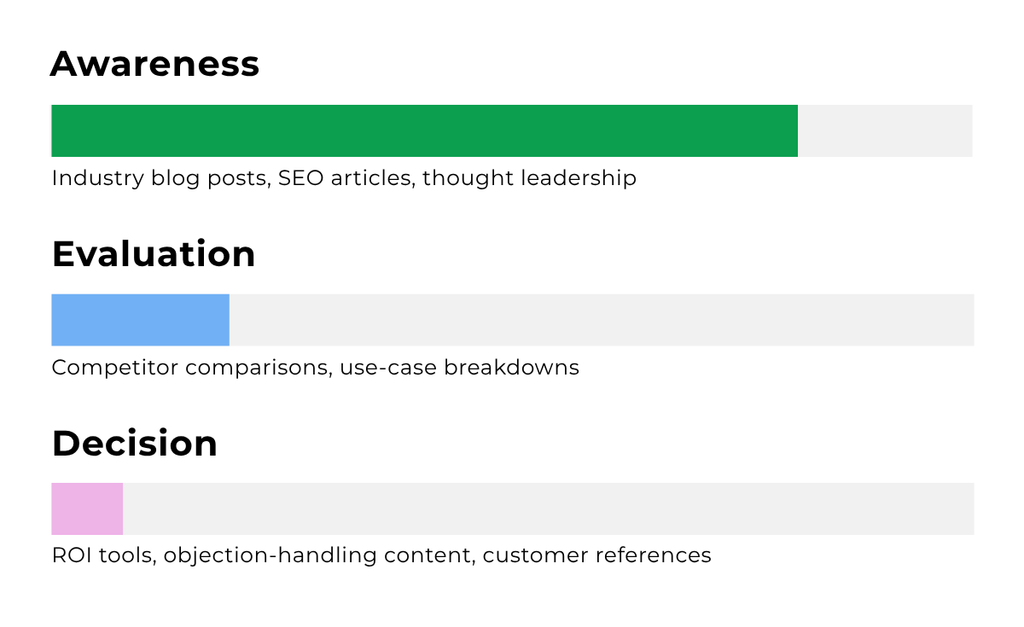
When you map the content library against buying stages, the pattern is almost always the same. There are plenty of awareness-level blog posts covering broad industry topics, and almost nothing that helps a buyer who’s already evaluating options. There’s rarely anything a prospect can use to compare this company against competitors or build an internal business case, and sales has nothing to send when a deal stalls on objections. The content was built to feed a publishing schedule, and it shows in the analytics: the blog gets traffic, but almost none of it converts to pipeline. Pages get one visit and nothing after. The content is either attracting people who will never buy or failing to give serious buyers a reason to go further.
Buyers now complete the majority of their research before they ever talk to sales, which means your content is the first conversation a prospect has with your company. With AI search changing how buyers find and evaluate vendors, the quality and specificity of your content now determines whether you appear in the consideration set at all.
The AI-generated content problem makes this even worse. Many portfolio companies have ramped volume using generative tools without editorial governance around quality, accuracy, or point of view. The result is a library of posts that are topically relevant and completely interchangeable with what competitors produced the same way. A 2026 Meltwater/YouGov study of nearly 10,000 consumers found that 32% would trust a brand less if they knew its content was AI-generated, while only 15% said it would increase trust. Continued volume without editorial governance pushes that ratio in the wrong direction.
5. Do Marketing and Sales Agree on What a Qualified Lead Looks Like?
It doesn’t, in the vague “alignment” sense that every consultant recommends. The specific, testable version: is there a written definition of a qualified lead that both teams operate from day to day? In practice, there almost never is. Marketing counts an MQL when someone downloads a whitepaper or attends a webinar, and sales considers a lead qualified when budget, authority, and timeline exist. Because those two definitions don’t match, marketing reports growing lead volume while sales ignores a significant percentage of what comes over, and every pipeline report built on those numbers paints a picture that doesn’t match what’s actually happening.
What happens after the handoff matters just as much. Is there an SLA on follow-up time? Does marketing get feedback on lead quality from the sales team? Does anyone track how much of the content and collateral marketing produces actually gets used in sales conversations? In most companies, nobody has checked.
6. Can Marketing Connect Its Work to Revenue?
This is where most portfolio companies are exposed. The operating partner needs to know whether marketing is generating a return, so the marketing department reports traffic, MQL volume, email engagement, social metrics. Those numbers are easy to produce and they almost always trend in a favorable direction, which is why they keep getting reported. But they don’t tell the board what it needs to know.
The question is actually whether the infrastructure exists to draw a line from marketing activity to pipeline and revenue:
- Can the team produce marketing-sourced pipeline by channel?
- Can they calculate customer acquisition cost?
- Do they know which campaigns influenced opportunities that closed?
Reports get assembled manually from disconnected systems and delivered with more conviction than the underlying data warrants. The operating partner receives a polished dashboard that looks authoritative but can’t answer the question that determines whether marketing keeps its budget next quarter.
The Five Findings That Show Up in Almost Every Diagnostic
Those are the questions worth asking, and here’s what the answers tend to look like.
Revenue Depends on a Few Relationships That Can’t Be Replicated
The pipeline report shows healthy numbers, until you trace the sources. In a typical portfolio company, a large share of closed-won revenue connects back to the founder’s personal network, one or two senior salespeople who’ve been with the company for years, or referral partners who send business based on personal trust rather than brand recognition. None of those channels transfer when ownership changes, and none of them can be replicated by increasing the marketing budget.
When the founder steps back into a board role and the senior rep eventually moves on, the pipeline they generated leaves with them.
The Company Describes What It Does, Not Why It Wins
Pull up the homepage and read the first three sentences. Then pull up two competitors and do the same thing. If you could swap the logos and the copy would still work, the company hasn’t actually figured out its position. This is how portfolio companies end up competing on price and relationships when the growth plan calls for market expansion. The sales team knows the product is good, but they can’t hand a prospect a clear answer about what makes this company distinct or what it stands for beyond the product itself.

The Blog Exists but the Content Doesn’t Convert
There’s content, sometimes quite a lot of it. But most of it covers awareness-level topics that attract early-stage traffic without helping anyone make a buying decision. The content that actually moves deals forward, the kind that helps a buyer build an internal business case or evaluate this company against competitors, barely exists. Meanwhile, the blog publishes weekly because someone decided that frequency was the goal, and the posts read like everything else already ranking for the same keywords.
Marketing and Sales Share a CRM but Not a Strategy
Marketing says they delivered 400 MQLs last quarter, and sales says maybe 60 of them were worth a phone call. (Those numbers are illustrative, but the ratio is one we see regularly.) The operating partner sees both numbers in the same pipeline review and can’t figure out why the conversion rate is so low. Nobody has a satisfying answer because the two teams never agreed on what “qualified” means in the first place.
Marketing optimizes for volume because that’s what their dashboard measures. Sales cherry-picks the leads that look promising and lets the rest sit in the CRM untouched. The two teams are each putting in real effort toward goals that don’t connect to each other.
Marketing Reports Look Healthy Until Someone Asks About Revenue
The quarterly pipeline review arrives and the operating partner asks how much revenue marketing generated. The conversation shifts to caveats and qualifications. The data exists in fragments across disconnected systems, and assembling a credible answer takes days of manual work that nobody has time for. Meanwhile, the monthly report has been showing favorable trends across traffic, email engagement, and MQL volume for months, so everyone assumed marketing was making progress. The numbers were easy to produce and they almost always trended in a favorable direction, which is why they kept getting reported. But they never answered the question that determines whether marketing keeps its budget next quarter, and nobody noticed until the operating partner asked it out loud.
Getting This Wrong Burns Time You Can’t Get Back
According to Bain’s 2026 Global Private Equity Report, buyout holding periods at exit now average around seven years, up from five to six years in the previous decade. A portfolio company that spends twelve months running campaigns against the wrong positioning and the wrong audience has lost time on the hold period that no amount of budget correction can recover. Buyers in B2B markets do the majority of their evaluation before they ever talk to sales, and AI tools mean every competitor can now publish at volume for a fraction of what it used to cost. Your positioning and content quality now determine whether you make the shortlist at all.
Meanwhile, operating partners have gotten more sophisticated about what they expect marketing to prove. “We’re building brand awareness” doesn’t survive the next board meeting as a standalone strategy.
The companies that understand what’s actually happening inside the marketing function before they start spending tend to outperform the ones that skip straight to tactics. That’s the principle behind every good diagnostic, and it’s the work Method Q was built around.
If your portfolio company hasn’t been through one, or if the last audit looked more like a channel scorecard than a capability assessment, we should talk.
If you recognized your company in any of what you just read, you can find out exactly where your funnel breaks in about three minutes. Method Q’s marketing assessment evaluates your function across five stages, from awareness and positioning through board-level measurement, and tells you which stage needs attention first.