

Private equity-backed companies operate under pressure most businesses never experience. With average holding periods stretching to over six years, portfolio company leadership teams face clear mandates: drive significant revenue growth, expand margins, and position the business for a premium exit.
The first instinct is to hire more marketers, SDRs, and coordinators. But every new salary compounds in your cost structure and pushes down EBITDA, the metric that drives exit multiples. In a $50 million revenue business running 20% EBITDA margins, a single marketing manager at $180,000 per year represents 1.8% of earnings. Multiply that across the team you think you need, and the impact on margins becomes hard to ignore.
The better path is building a demand generation system rather than expanding the department.
Why PE-Backed Companies Need Systems, Not Headcount
PE-backed companies typically run leaner marketing budgets than their growth targets suggest.Industry benchmarks consistently show that PE-backed firms allocate a smaller share of revenue to sales and marketing than venture-backed peers, while facing similarly aggressive growth expectations.
This creates a specific problem: sustaining mid-20% annual growth on lean budgets is difficult using traditional campaign-based marketing. Campaigns consume resources, produce results while spending is active, then fade when attention shifts. Over a multi-year holding period, this approach burns cash without building anything durable.
This pattern is common across PE-backed portfolio companies. The marketing team runs hard on quarterly campaigns, reports decent numbers while spending is active, then watches pipeline dry up the moment the budget shifts to the next initiative. Because none of it lasts, every quarter effectively starts from zero.
Demand generation systems work differently. A content library that ranks in search attracts prospects next month and next year. A lead scoring model improves with every sales cycle, and nurture flows run while your team sleeps. The upfront investment is real, but the returns grow over time instead of stopping when the budget does.
PE operating partners evaluate marketing through one lens: can we hit growth targets while protecting margin? A system gives you a credible answer. A growing headcount doesn’t.
Private equity-backed companies operate under pressure most businesses never experience. With average holding periods stretching to over six years, portfolio company leadership teams face clear mandates: drive significant revenue growth, expand margins, and position the business for a premium exit.
The first instinct is to hire more marketers, SDRs, and coordinators. But every new salary compounds in your cost structure and pushes down EBITDA, the metric that drives exit multiples. In a $50 million revenue business running 20% EBITDA margins, a single marketing manager at $180,000 per year represents 1.8% of earnings. Multiply that across the team you think you need, and the impact on margins becomes hard to ignore.
The better path is building a demand generation system rather than expanding the department.
Why PE-Backed Companies Need Systems, Not Headcount
PE-backed companies typically run leaner marketing budgets than their growth targets suggest. Industry benchmarks consistently show that PE-backed firms allocate a smaller share of revenue to sales and marketing than venture-backed peers, while facing similarly aggressive growth expectations.
This creates a specific problem: sustaining mid-20% annual growth on lean budgets is difficult using traditional campaign-based marketing. Campaigns consume resources, produce results while spending is active, then fade when attention shifts. Over a multi-year holding period, this approach burns cash without building anything durable.
This pattern is common across PE-backed portfolio companies. The marketing team runs hard on quarterly campaigns, reports decent numbers while spending is active, then watches pipeline dry up the moment the budget shifts to the next initiative. Because none of it lasts, every quarter effectively starts from zero.
Demand generation systems work differently. A content library that ranks in search attracts prospects next month and next year. A lead scoring model improves with every sales cycle, and nurture flows run while your team sleeps. The upfront investment is real, but the returns grow over time instead of stopping when the budget does.
PE operating partners evaluate marketing through one lens: can we hit growth targets while protecting margin? A system gives you a credible answer. A growing headcount doesn’t.
The Four Components of a Demand Generation System
Four pieces of infrastructure form the foundation, and each one addresses a specific stage of how B2B buyers actually make decisions.
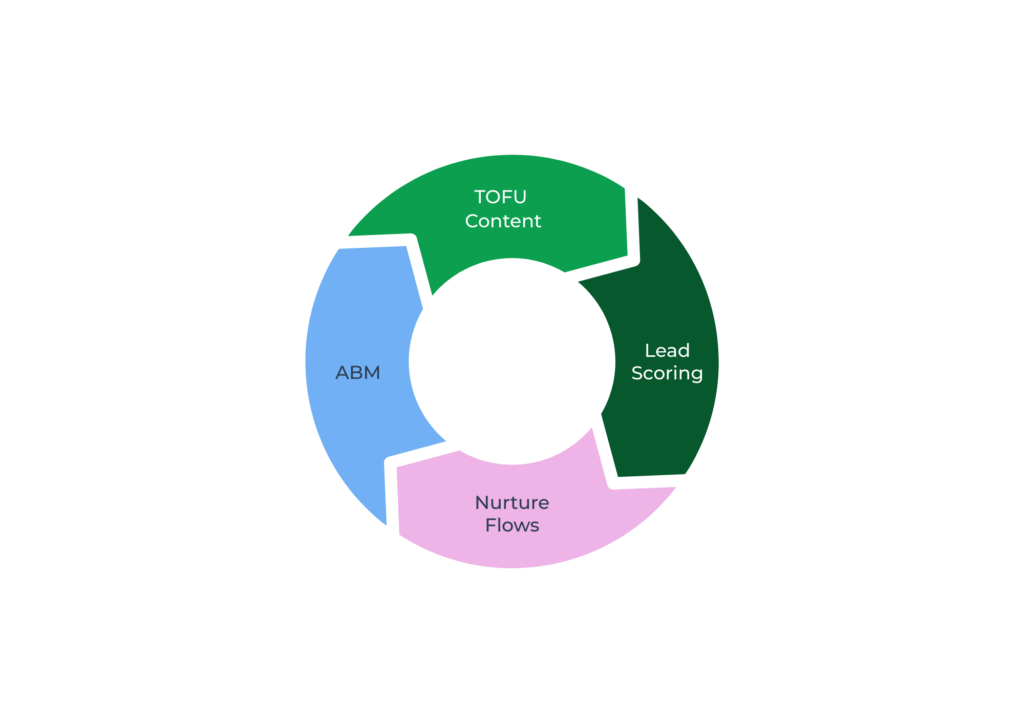
1. A Top-of-Funnel (TOFU) Strategy That Compounds
Top-of-funnel content forms the foundation of efficient demand generation. Research shows 61% of B2B buyers prefer completing research without sales contact. This creates opportunity for companies willing to invest in content that ranks well, gets cited by AI systems, and positions them as credible sources.
The efficiency argument is straightforward. Based on 2025 CAC benchmarks compiled by Phoenix Strategy Group, organic and referral-driven acquisition typically delivers lower CAC than paid channels, while paid B2B search averages around $800. More importantly, organic content keeps delivering. A blog post published today continues attracting traffic and generating leads months or years later without additional spending.
Start with problem-focused topics that match search intent, not product pitches. Buyers researching solutions want frameworks for evaluating options and tools for building business cases.
The content hub model provides the architecture: identify 3-5 pillar topics representing how your buyers think about their challenges, then develop 10-15 supporting pieces per pillar addressing specific questions, use cases, or decision criteria. This structure creates topical authority that search engines and AI systems recognize.
Implementation requires discipline but not massive resources. You simply need one strong writer who understands your category to produce two pillar pieces per quarter and two supporting pieces per month. The value compounds as search rankings improve and your content library grows.
Track organic traffic growth, keyword rankings, and content-sourced pipeline., and calculate CAC by channel to demonstrate the efficiency gains content delivers. For structure around content strategy, our guide on creating a content marketing plan provides frameworks for building this systematically.
2. Lead Scoring That Sales Actually Trusts
Lead scoring is where demand generation systems either earn or lose credibility with sales teams. In PE-backed companies, sales reps are measured on efficiency and conversion rates. When marketing sends over leads that waste their time, trust erodes quickly, and recovering it takes time.
Effective scoring combines behavioral signals with firmographic fit. The behavioral side reveals intent: someone visiting your pricing page three times, downloading a case study, and reviewing product documentation is telling you something. Firmographic fit determines whether their company matches your ideal customer profile in terms of size, industry, and geography.
Start with five signals that reliably predict buying intent in your business:
- Pricing page visits (research shifting to evaluation)
- Case study downloads (seeking proof from similar companies)
- Multiple return visits in a compressed timeframe (active evaluation underway)
- Demo or consultation requests (explicit buying interest)
- Product page engagement across multiple features (moving from awareness to consideration)
Once you assign point values and set thresholds (50 points triggers a sales notification, 100 points goes directly to a rep), test and refine based on what actually converts.
Negative scoring matters just as much. Automatically disqualify competitors, companies outside your serviceable geography, organizations below your minimum deal size, and job seekers researching your company. Every bad lead that reaches sales undermines the system’s credibility.
Schedule monthly alignment meetings between marketing and sales to review which qualified leads converted and which didn’t. Identify what patterns explain the difference, and adjust scoring rules accordingly. The goal is fewer leads overall, but higher conversion rates.
3. Multi-Touch Nurture Flows That Run Without You
Most prospects who engage with your content are not ready to buy. Multi-touch nurture flows solve this problem by maintaining engagement with prospects who need time without consuming sales resources on conversations that won’t convert.
These automated sequences educate prospects, build credibility, and identify buying signals without manual intervention. Prospects move through defined paths based on their behavior, company characteristics, and engagement patterns.
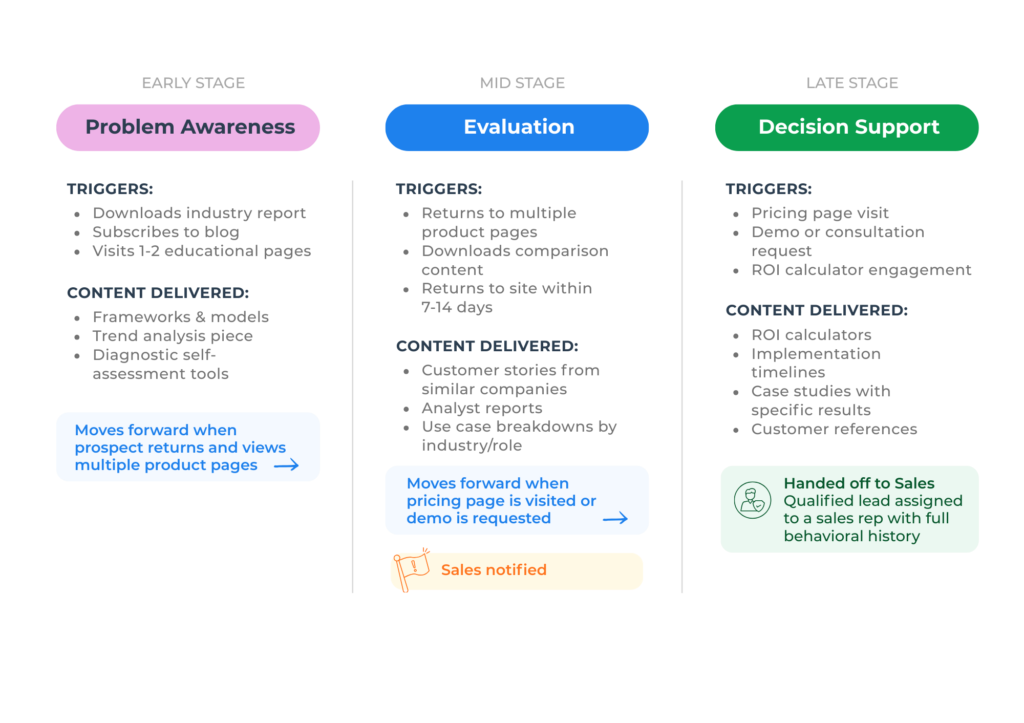
Structure flows around where prospects are in their buying process:
Early-stage flows deliver educational content that builds problem awareness. Someone downloading an industry report enters a sequence providing related frameworks, trend analysis, and diagnostic tools. The goal is positioning your company as a credible source, not selling your product.
Mid-stage sequences provide proof and comparative context. When visitors return to multiple product pages, they enter a nurture track featuring customer stories from similar companies and analyst reports.
Late-stage automation supports buying decisions. Pricing page visits or demo requests trigger messages with ROI calculators, implementation timelines, case studies, and customer references.
Triggers determine flow entry and progression. Behavioral triggers respond to actions, such as form fills, page visits, content downloads, while time-based triggers move prospects through sequences when they don’t take action. You should segment by industry, company size, or role for better performance.
Once built, these systems operate with minimal ongoing manual intervention. A prospect entering your database receives appropriate content, progresses through defined stages, and surfaces to sales when behavioral signals indicate readiness. That operational leverage lets small marketing teams support demand generation at scale.
For companies re-evaluating their approach, our article on why outdated marketing strategies hurt lead generation covers the gaps that nurture automation addresses.
4. ABM for Tier-1 Accounts
If a small percentage of your customers generate the majority of your revenue, your demand generation strategy should reflect that concentration. Account-based marketing focuses resources on the accounts that justify the investment, and for PE operating partners evaluating marketing spend, the logic is straightforward: concentrate effort where deal sizes materially impact growth targets.
Account selection:Work with sales leadership to identify 20 to 50 tier-1 accounts based on revenue potential, strategic fit, and likelihood to close within a relevant timeframe.
Research comes first: Before any outreach, understand each account’s business priorities, buying committee composition, competitive landscape, and the specific problems your solution addresses. This intelligence shapes everything that follows.
Personalize the approach: Generic product decks don’t work at this level, so build account-specific business cases. Create custom analyses showing how your solution addresses their particular situation. Tailor content to different members of the buying committee based on their role and concerns.
Coordinate across channels: Your mix should include email, LinkedIn, targeted advertising, and direct mail for the highest-value accounts.The goal is consistent visibility across the channels the buying committee actually uses, not a single-channel blitz they can ignore.
Align sales and marketing on shared account plans: Both teams work from the same intelligence, the same priorities, and the same next actions. Weekly account reviews keep momentum and allow real-time adjustments based on engagement signals.
Measure what PE cares about: Pipeline generated from target accounts, deal velocity compared to your standard sales cycle, average contract values from ABM accounts versus your broader pipeline, and ABM-sourced revenue as a percentage of total growth.
The Metrics PE Firms Actually Care About
PE firms evaluate marketing through the lens of enterprise value. Vanity metrics like impressions, followers, and email open rates do not belong in a board deck. What does matter are efficiency, payback, and the ability to convert spend into predictable revenue.
Customer Acquisition Cost (CAC) tracks total sales and marketing expenses divided by new customers acquired. In many B2B SaaS businesses, CAC has increased in recent yearsas competition and channel costs have risen, making efficiency trends more important than point-in-time performance.
New CAC Ratio measures how much you spend to acquire one dollar of new annual recurring revenue. This ratio varies widely across companies and stages. For PE-backed businesses, the direction of the trend as the company scales matters more than the absolute number in any single quarter.
LTV:CAC Ratiocompares customer lifetime value to acquisition cost. A 3:1 ratio is commonly cited as a healthy target, though acceptable ranges vary by business model, margin profile, and growth strategy. Sustained performance below that level often signals acquisition spending that is not delivering durable returns.
CAC Payback Period measures how many months it takes for a new customer to generate enough gross profit to recover acquisition costs. Many B2B SaaS companies aim for payback periods in the 12–18 month range, as longer ones can strain cash flow and limit flexibility during a holding period.
Pipeline Coverage Ratio shows how much qualified pipeline exists relative to revenue targets. Most growth-stage businesses operate with roughly 3–4x coverage. Ratios below that level increase execution risk and make forecast accuracy harder.
Marketing-Sourced Revenue tracks how much closed revenue originated from marketing, rather than being merely influenced by it. Strong demand generation programs often show a meaningful share of new revenue originating in marketing, though the exact percentage varies by sales motion and deal size. This metric helps boards distinguish between marketing as a cost center and marketing as a revenue engine.
Track these metrics monthly and review them quarter over quarter. When CAC stabilizes or declines, payback periods shorten, and marketing-sourced revenue grows as a share of new bookings, marketing is contributing to enterprise value creation. That’s the narrative PE firms want to see heading into an exit.
What to Build First: A 90-Day Implementation Plan
Most PE-backed companies cannot build an entire demand generation system simultaneously. Resource constraints and the need to maintain current revenue generation mean implementation must be phased and prioritized.
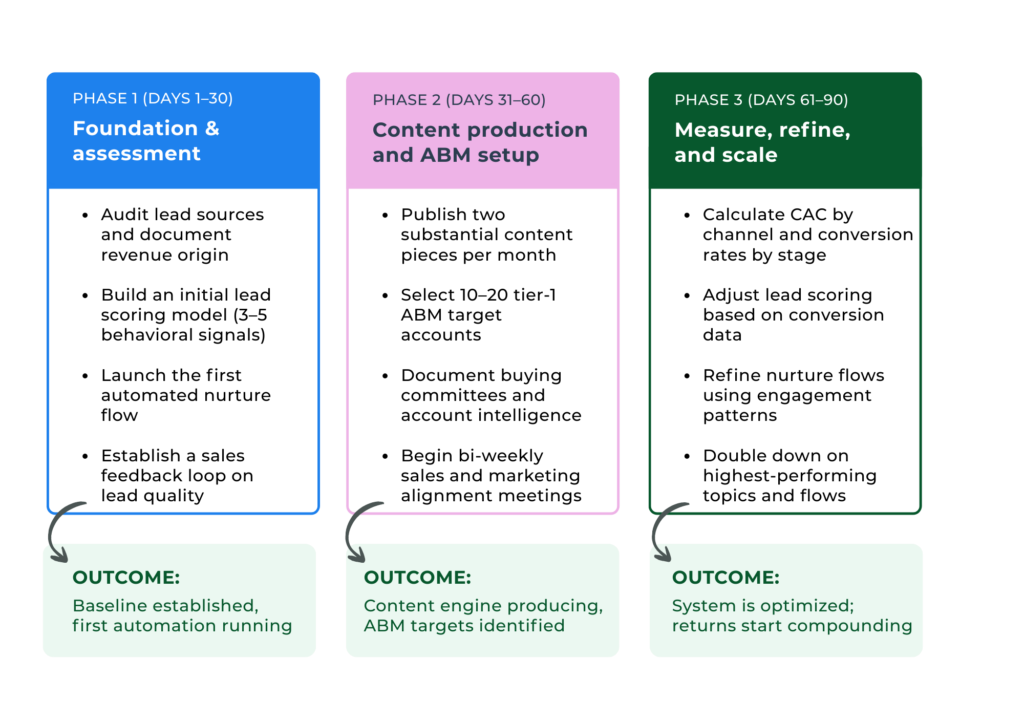
This 90-day plan provides a realistic sequence for companies starting from traditional campaign-based marketing or minimal marketing infrastructure.
Days 1-30: Foundation and Assessment
- Audit your current state. Document where leads actually come from, how they get qualified, what happens after a form fill, and which activities contribute to closed revenue. Most companies find significant gaps between what they assume is happening and what the data shows. We’ve worked with portfolio companies that discovered their “top-performing” channel was actually generating leads that almost never converted to revenue.
- Implement basic lead scoring. Identify three to five behavioral signals that indicate buying intent and build a simple scoring model. If you need to start with manual processes, that’s fine. Have sales reps review scored leads and provide feedback. The goal is proving the concept and establishing the feedback loop between marketing and sales.
- Launch your first nurture flow. Pick one high-volume entry point, such as blog subscribers or content downloads, and build a five to seven email sequence that educates prospects and surfaces buying signals. This flow should run without manual intervention, removing follow-up tasks from your team’s plate.
Days 31-60: Content Production and ABM Setup
- Establish a content production cadence. Commit to publishing two substantial pieces per month focused on buyer problems. Target search terms your prospects actually use. Address questions that come up early in their buying process, before they’ve identified specific vendors.
- Select ABM target accounts. Work with sales to identify 10 to 20 tier-1 accounts worth focused marketing effort. Document why each account matters, what problems they face, who sits on the buying committee, and what would differentiate you from their alternatives.
- Align sales and marketing on lead quality. Schedule bi-weekly meetings where both teams review which marketing-qualified leads converted, which ones stalled, and what patterns explain the difference. Use these insights to adjust scoring rules and improve lead quality iteratively.
Days 61-90: Measurement, Refinement, and Scale
- Measure what’s working.Calculate CAC by channel, track pipeline from different sources, and document conversion rates at each stage. If you need a primer on the tracking infrastructure, our guide to Google Search Console and Google Analytics covers how these tools work together. Identify which activities deliver the best efficiency and which consume resources without producing results.
- Refine based on results. Adjust lead scoring thresholds using actual conversion outcomes. Update nurture flow messaging based on engagement patterns. Shift content topics toward whatever generates the most qualified traffic and pipeline.
- Double down on what works. If content on a particular topic generates qualified traffic, produce more in that area. If a specific nurture flow converts well, build similar flows for other entry points. Systematic scaling of what’s proven is how you get compounding returns.
Resources you’ll need:
Building and maintaining a demand generation system requires clear ownership and architectural discipline. The work is less about executing individual campaigns and more about designing how content, scoring, automation, and sales alignment operate together over time.
In many PE-backed companies, this responsibility does not map cleanly to a junior marketing hire or a narrowly scoped functional role. It requires someone who can evaluate trade-offs, sequence investments, and adjust the system based on performance data rather than activity levels.
Some portfolio companies address this gap through fractional leadership. A fractional CMO or senior marketing operator can define the structure, establish measurement standards, and guide early implementation without permanently increasing the cost base. Because this model is typically time-bound and outcome-driven, it allows companies to build durable infrastructure before committing to long-term headcount.
From an operating perspective, this approach emphasizes leverage over scale. The focus is on putting repeatable systems in place that continue to perform as the organization grows, rather than expanding the team to keep up with demand. For PE-backed businesses balancing growth targets with margin discipline, this can be an effective way to resource marketing during periods of transition or acceleration.
Building Marketing That Creates Enterprise Value
The portfolio companies consistently hitting growth targets have something in common: they built marketing infrastructure that grows revenue without growing costs at the same rate. Returns compound as systems mature, content ranks, scoring models learn, and nurture flows optimize.
For PE operating partners evaluating a portfolio company’s marketing function, this is the story that supports value creation narratives, proves revenue can expand without proportional G&A increases, and delivers improving unit economics as margins widen.
If you are ready to build a demand generation system that proves marketing’s impact on EBITDA, Method Q brings the Scientific Method to marketing strategy. We partner with PE-backed companies to build the systems that scale pipeline without scaling headcount.
Let’s talk about building marketing infrastructure that supports growth and positions your company for a premium exit.