
Your marketing team is busy. They're producing content, running campaigns, managing paid spend, attending events, updating the CRM, and reporting on it all. The work is real, and the budget spent on it isn't small.
So why does every quarter feel like a restart?
Pipeline evaporates when attention shifts, and last quarter's campaigns don't carry forward into this quarter's results. The content calendar keeps filling up, but the output sits next to itself. None of it builds on what came before. You look at the numbers and wonder how a team this active can produce results this flat.
When marketing leaders see this, the first instinct is to blame the tactics and start swapping things out. New channels, new agency, new tech stack, new team structure. Ninety days later, the same pattern shows up again.
The order you built your marketing in is what determines whether the work stacks or resets. Most companies have never examined that order. So the reset keeps happening.
What broken B2B marketing actually looks like
You already know the symptoms, even if you haven't named them as a single pattern. Content gets published on a cadence, but it doesn't connect to a documented positioning strategy because positioning was never formalized. Lead scoring definitions exist in the marketing automation platform, but sales doesn't trust them because nobody agreed on the criteria before campaigns started sending leads over. Paid campaigns point at landing pages with messaging that was written for a different ICP two years ago. Activity metrics go to the board because outcome metrics can't be traced back to anything specific.
The four symptoms above are the same problem wearing different costumes. The marketing function was assembled out of sequence, and the pieces don't reinforce each other because they were never designed to.
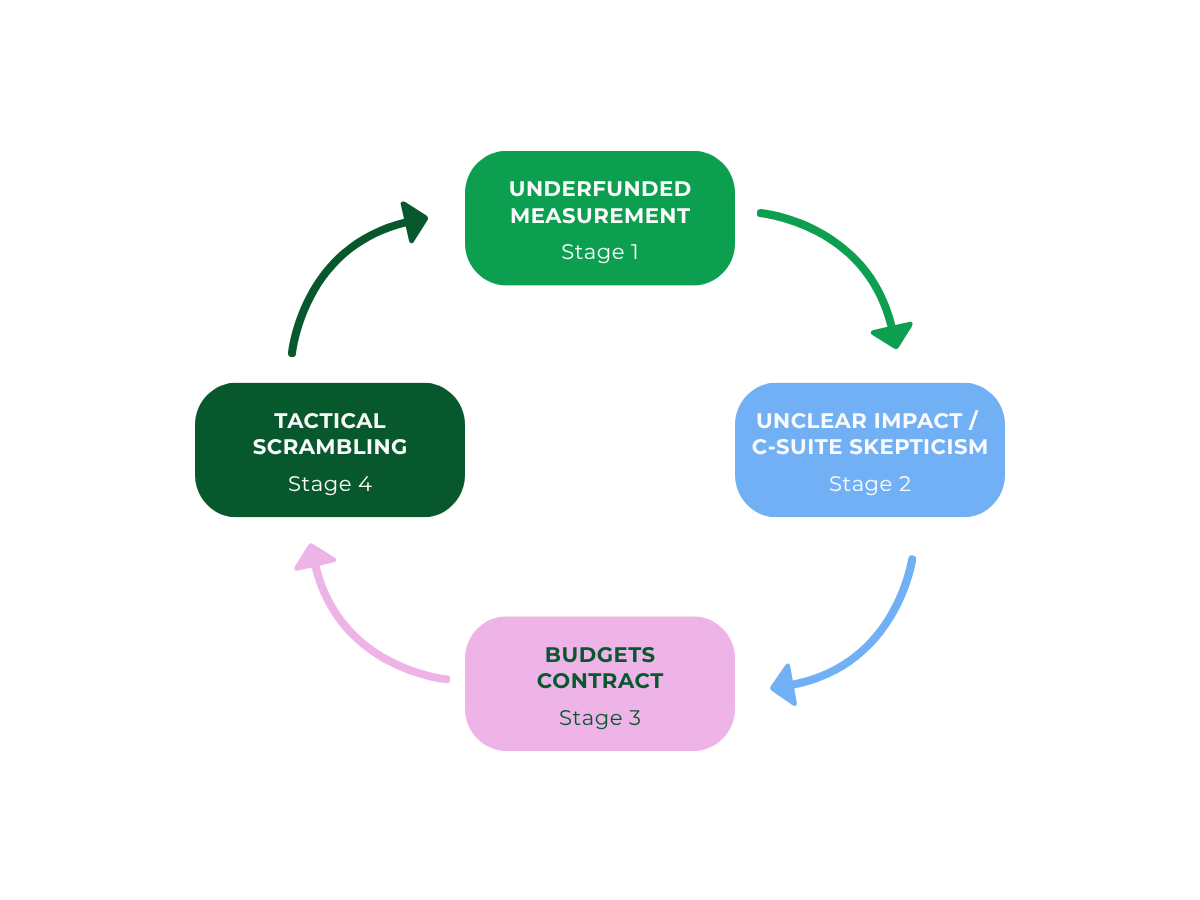
There's data behind this pattern, and none of it is flattering. A Gartner survey of 174 senior marketing leaders found that half of CMOs identify short-term needs impeding long-term strategic planning as their most pressing challenge. And a separate Gartner study found that 84% of companies are stuck in what the firm calls a brand "doom loop." Underfunded measurement leaves impact unclear, the C-suite loses confidence, budgets contract, and tactical scrambling fills the space where strategic investment used to sit. Each step makes the next one harder to reverse.
The teams living through this pattern usually know something is off. Forrester reported that only 12% of marketing leaders believe their team's current organizational design will help them meet revenue targets, which means 88% of marketing leaders are aware of structural problems they don't yet know how to address. The pressure to keep producing makes it very difficult to stop and rebuild while the machine is still running.
The order you built your marketing in is what determines whether the work stacks or resets.
Why B2B marketing sequence matters more than channel selection
Sequence is the single most important variable in whether a B2B marketing program produces durable results or restarts every quarter. It's also the variable most companies never examine.
Every B2B marketing team argues about what to do next. The debate cycles through channel mix, ABM versus broad demand gen, whether to lean into events or pull back, what the AI strategy should look like this quarter. These are reasonable conversations, and most companies have them quarterly or annually.
Almost nobody asks whether they're doing these things in the right order.
Sequence determines whether the work your team does today makes tomorrow's work easier or whether it just sits next to it. A content library built on clear positioning attracts the right audience and gives sales a reason to share it. A content library built before positioning was defined attracts traffic that doesn't convert and ends up unused in a shared drive.
Think about it the way you'd think about building a house. Nobody argues about whether a house needs a roof. The question is whether you pour the foundation first. Marketing works the same way, and the roof is what most companies build first. The pieces most companies invest in (content programs, paid campaigns, events, ABM, nurture sequences) are all real and necessary. What matters is whether they were built on top of the layers that make them function, or whether those layers got skipped in the rush to show activity.
The clearest test is what happens when something pauses. Stop the paid budget for sixty days. If pipeline freezes too, you built a campaign. If it keeps producing, you built a system.
The correct build order
The correct order for building a B2B marketing function is diagnosis first, then strategic foundation, then operational alignment, and finally tactical execution. Each layer exists to make the layer above it work. When a team skips ahead, the deficit shows up later, usually as the quarterly reset we just described.
This applies whether you're building a marketing function for the first time or rebuilding one that's been running for years. The founder-led company whose "marketing" has always been the founder's network needs the same sequence as the team with twelve people and a marketing automation stack. The only difference is that one is starting from zero and the other has to undo work that was already built in the wrong order.
Stage 1: Diagnose the Funnel
Before you build anything, understand what's actually happening. Where do prospects enter your funnel, and where do they fall out before sales gets involved? How does your sales team describe lead quality when no one from marketing is in the room? How much daylight is there between what your dashboards show and what your team assumes is happening?
Most companies skip this step because they think they already know the answer, or because the pressure to launch something feels more urgent than the work of figuring out what's broken. Diagnosis is what prevents you from solving the wrong problem. A company investing heavily in top-of-funnel content when the real issue is a mid-funnel handoff problem will produce a lot of traffic and very little pipeline. We see this regularly: teams running hard on the wrong problem because nobody paused to identify the right one.
Diagnosis also establishes the baseline that every future decision gets measured against. Without that baseline, there's no way to tell whether a new campaign actually changed your numbers or just generated activity that looks good in a slide deck.
Stage 2: Build the Strategic Foundation
Once you know what's actually happening, you can define the strategic layer. This is umbrella messaging, positioning, messaging clarity, ICP definition, and the documented answers to questions like: Who are we for? What do we believe? How do we talk about what we do? Why should anyone care?
This is the layer most companies skip entirely or complete informally. Somebody wrote a positioning statement two years ago and filed it. The sales deck has a value prop slide that hasn't been touched since the last rebrand. Ask five people on the marketing team to describe the company's umbrella message, and you'll get five different answers. When content gets produced without consistent strategic messaging underneath it, every piece is a standalone effort, and nothing reinforces anything else because there's no shared source of truth for what the brand actually stands for.
The strategic foundation is what turns a collection of marketing activities into a coherent program. It's also what makes content credible over time, because a body of work built on consistent messaging reads differently than a collection of disconnected posts.
Stage 3: Align Operations and Measurement
With a diagnosis and a strategy in place, the next layer is the operational one. This is where you define the mechanics. What does a qualified lead actually mean, and do sales and marketing agree on the definition? Which metrics reflect business outcomes, and which are just reporting on activity? Who owns what, and what does the handoff between marketing and sales actually look like in practice?
This is the least exciting stage, and it's the one that gets funded last if it gets funded at all (nobody has ever been promoted for documenting a lead scoring methodology). It's also the difference between a marketing function that can prove its impact and one that reports on open rates and impressions because those are the only numbers it can confidently produce.
When Gartner reports that marketing budgets have flatlined at 7.7% of company revenue and 59% of CMOs say they have insufficient budget to execute their strategy, the measurement layer is a significant part of the story. If marketing can't demonstrate how spend connects to outcomes, it has no leverage in budget conversations. The doom loop starts here.
Operational alignment is also where demand generation systems start producing results that build on each other and survive between campaigns. Lead scoring, nurture flows, attribution models, and sales-marketing alignment meetings are all operational layer work. The work doesn't look glamorous from the outside, and it's what makes everything above it measurable and defensible.
Stage 4: Launch Tactical Execution
Content, paid media, events, ABM programs, nurture sequences, social, and email is the work most companies start with. When the tactical layer sits on top of the first three, the pieces start reinforcing each other. Content built on clear positioning attracts buyers who match your ICP. Paid campaigns pointed at aligned messaging convert at higher rates because the destination matches the promise. Nurture flows informed by an actual diagnosis address the right problems at the right stage of the funnel, which is why your subscribers actually open them.
Flip the sequence and the work falls apart. Content goes out on the calendar's schedule with no underlying positioning logic guiding what gets published. Campaigns launch because the budget needs spending before quarter-end closes. Events get attended out of industry obligation, even when no one on the team can explain how attendance connects to pipeline. By the time the quarter closes, the team is staring at a blank slate because nothing they did was designed to build on anything else.
The sequence is the argument. Diagnosis, then strategy, then operations, then execution. Each layer exists to support the one above it. Skip a layer and the layers above it are unstable. Skip two and you're rebuilding every quarter.
The sequence is the argument. Diagnosis, then strategy, then operations, then execution.
How to recognize you've built yours backwards
If you just inherited the marketing function from a predecessor, ended an agency relationship that wasn't producing pipeline, or are reassessing the function after a change in ownership or leadership, these are the questions to start with. Most marketing leaders can answer them honestly without a formal audit, and the answers tell you exactly where the build order broke.
Can two people on your marketing team independently describe the same ICP, or do you get meaningfully different answers? If the answers diverge, the strategic foundation is either missing or informal enough that it's not actually guiding decisions.
If you paused all paid campaigns for 60 days, would pipeline generation continue or stop? If it stops, your marketing is a campaign, and campaigns reset by definition.
When your CMO presents to the board, are the metrics about marketing activity or about business outcomes? Most CMOs know better than to lead with impressions. The problem is the operational layer between campaign execution and outcome measurement. The systems and processes that should connect spend to business results either don't exist or aren't built to show the proof behind the narrative.
Does your sales team use the materials marketing produces, or have they quietly built their own deck? When sales builds its own collateral, it's usually because the positioning in marketing's materials doesn't match what actually resonates in conversations with buyers.
Can you trace a closed deal back to the first marketing touchpoint, or does attribution functionally start at the demo request? Understanding how buyers actually move through their journey requires measurement architecture, and most teams build it well after launching the campaigns it should have been tracking from day one.
None of these questions are easy to answer. The honest answers point to where in the sequence steps got skipped, which is also where the reset originates each quarter.
What durable B2B marketing requires
Marketing that produces durable results is built methodically, one proven step at a time. The apparent effortlessness of the output disguises how much sequenced work sits underneath it. The campaigns, the pipeline, the brand consistency, the predictable revenue contribution that lets a CMO defend their budget in a tough board meeting, all of it is the visible output of layers nobody outside the team ever sees.
That belief shapes how we work, and it's why every engagement we run begins with a diagnosis. When a marketing function resets every quarter, somebody skipped steps in the build order. The fix is going back and building the layers that were missed.
If your marketing is busy but not building, we'd love to have that conversation.
Request a workshop with Method Q.
FAQs
Why does my B2B marketing feel like it resets every quarter?
The most common cause is a sequencing issue. When teams start with tactical execution (content, paid, events) before building the foundational layers underneath (diagnosis, strategy, operational alignment), every initiative is standalone. Results last as long as spending or attention continues, then fade when priorities shift. The fix is identifying which foundational layers were skipped and building them, even while campaigns are running.
What should a B2B marketing team prioritize first?
Diagnosis. Before investing in new campaigns or channels, understand what's actually happening in your current funnel. Where are prospects entering and where are they dropping off? What does the data show versus what the team assumes? Most marketing teams skip this step because they feel pressure to launch something visible, but diagnosing the real problem prevents months of solving the wrong one.
How do I know if my marketing strategy is actually working?
If pausing your marketing for 60 days would cause pipeline to dry up, what you've built is campaign-dependent and resets by definition. A marketing function built in the right sequence produces output that survives without constant feeding. The clearest test is whether your work keeps producing results after the active investment in it stops.
What's the difference between a marketing campaign and a marketing system?
A campaign delivers results during the window it's running and stops producing when that window closes. A system keeps producing output between campaigns, because the layers underneath the campaigns (diagnosis, strategy, operational alignment) were already in place when the tactical work launched. With those layers built, each tactical investment reinforces the others. Without them, each campaign is an isolated effort that produces a spike and fades. We wrote about how to build demand generation that scales pipeline without scaling cost in the context of PE-backed companies, and the structural logic applies broadly.
How long does it take to fix a backwards build order?
It depends on how many layers were skipped and how much existing work needs to be aligned to a new foundation. Diagnosis is usually a matter of weeks. Strategic foundation work takes longer, since positioning and messaging decisions ripple through every downstream tactic, and operational alignment is an ongoing practice with no finite end date. As a realistic benchmark, a quarter of focused work usually gets the tactical layer producing durable output, and the returns strengthen from there.