

Your security expertise is already shaping your company’s revenue, whether you realize it or not.
When a prospect reads a technical breakdown your team published, that’s demand generation. When a buyer’s security team insists on talking to a peer before signing and your name comes up, that’s demand generation. When your conference talk gets referenced in a deal cycle six months later, that’s demand generation.
Most cybersecurity leaders participate in demand gen without calling it that. Whether you’re a CISO, a VP of Security, or a senior architect, the pattern is the same: it happens accidentally, in fragments, without a system behind it. Which means your company captures a fraction of the value your expertise could drive.
B2B cybersecurity sales cycles stretch for months. Buyers complete the majority of their research before they ever talk to a vendor. The content and credibility that shape those early decisions depend on the kind of technical depth that only your security team can provide, and that’s the piece most cybersecurity companies leave unfilled.
This is why your marketing team needs you involved, and what that involvement actually looks like.
What Demand Generation Actually Looks Like in Cybersecurity
Demand generation is the work that happens before a buyer ever talks to your sales team.
Liz Farquhar, VP, Paid Media at Method Q, puts it this way: “Only about 5% of your total addressable market is actively buying at any given time. The other 95% either don’t know they have the problem your platform solves, don’t think it’s urgent enough to act on, or aren’t aware you exist. Demand generation is what moves people from that 95% into the 5%, and makes sure your brand is already on their shortlist when they get there.”
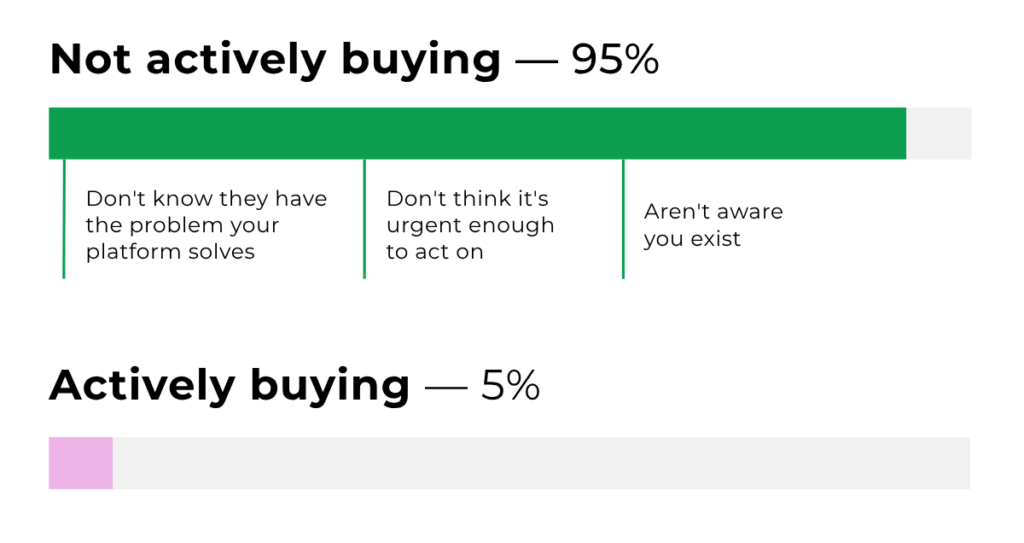
In B2B cybersecurity, that 95/5 split is more pronounced than in most categories, and the buyers who do enter the market take longer to close. Sales cycles often stretch for months, and buyers complete over 80% of their research before they ever engage a vendor. By the time your sales team gets a call, the prospect has already read the blog posts, watched the webinars, checked comparison pages, and asked their network who they trust.
That early research is where deals are won or lost. And most of what shapes a buyer’s thinking during that window (technical credibility, proof of expertise, etc.) is knowledge that lives inside your security team, not your marketing department.
The marketing team knows how to build the systems: content strategy, nurture sequences, paid campaigns, and pipeline tracking. What they often lack is the subject matter depth that makes cybersecurity buyers take the content seriously. That’s the piece CISOs provide.
Why CISOs Should Care About Demand Generation
CISOs won’t own demand generation. But in a B2B SaaS cybersecurity organization, the people with the deepest technical credibility are sitting outside the marketing function, and that creates a problem your marketing team can’t solve alone.
Your Buyers Trust Expertise More Than Marketing Materials
Here’s the business case in two numbers. According to the 2025 Edelman-LinkedIn B2B Thought Leadership Impact Report, 73% of decision-makers say an organization’s thought leadership is a more trustworthy basis for assessing its capabilities than its marketing materials. And 86% said they would be more likely to invite a company to bid on a project if that company consistently produced high-quality thought leadership.
That tells you something specific: buyers are actively looking for evidence that the people behind a product understand the problem at a technical level. In cybersecurity, that evidence has to come from practitioners. A marketing team can write a polished ebook about zero-trust architecture, but the technical depth that makes it credible has to come from somewhere. A buyer’s security team will know the difference between content informed by practitioners and content that’s working from surface-level research.
CISOs carry years of hands-on experience with the threats, compliance requirements, and architectural trade-offs that your buyers deal with daily. When that expertise shows up in published content, it signals something a product page never can: this company has people who have done the work.
Proofpoint’s 2025 Voice of the CISO Report is a good example. The report features security decision-makers speaking directly about their challenges, expectations, and priorities. Content like that builds the kind of authority that earns shortlist consideration because the credibility comes from the practitioners, not from the marketing department.
Product Adoption Protects The Revenue Your Sales Team Already Closed
Winning a deal and keeping a customer are two different problems. In cybersecurity SaaS, churn often starts with poor adoption: buyers purchase a platform, their team never fully implements it, and renewal considerations become uphill battles. For companies with long sales cycles and high acquisition costs, every churned account is revenue your demand gen investment already paid to acquire.
CISOs sit at the center of this because they understand how the product gets deployed. They know which configurations matter for specific compliance frameworks, which features solve real operational problems versus which ones sound good in a demo, and where teams typically get stuck during rollout. That knowledge is the foundation of product education that actually works.
When a CISO contributes to onboarding materials, technical walkthroughs, or implementation guides, the content carries weight that a marketing-produced tutorial doesn’t. A security team evaluating whether to renew a platform is more likely to trust guidance that comes from someone who has lived the same experience they’re dealing with.
This also feeds demand gen directly. Strong product education (use cases, configuration walkthroughs, etc.) doubles as mid-funnel and late-funnel material. A prospect comparing vendors will find their way to your implementation documentation, and the depth of that content signals whether your company understands deployment at scale or just sells it well.
CISO Involvement Compresses Sales Cycles
In enterprise and mid-market cybersecurity deals, there’s a predictable moment where momentum stalls: the buyer’s security team has technical questions that your sales rep and solutions engineer aren’t equipped to answer to the depth they need. Procurement wants a compliance review, but the buyer’s CISO wants to talk to a peer.
When your CISO is available for those conversations, even selectively, deals tend to move faster. A 30-minute call between security leaders can resolve concerns that would otherwise bounce between teams for weeks.
That has a direct effect on pipeline velocity. Deals that would otherwise stall in technical review move forward faster because the objections get addressed before they become blockers. And buyers leave those conversations with a level of confidence that no PDF or product demo replicates.
For a cybersecurity SaaS company running long sales cycles, even a modest reduction in average time-to-close directly improves forecasting accuracy, quarterly revenue targets, and the return on every dollar your marketing team spent building that demand.
How CISOs Can Contribute to Demand Generation
The argument so far is that a CISO’s expertise has marketing value a company probably isn’t capturing. So what can actually be done about it?
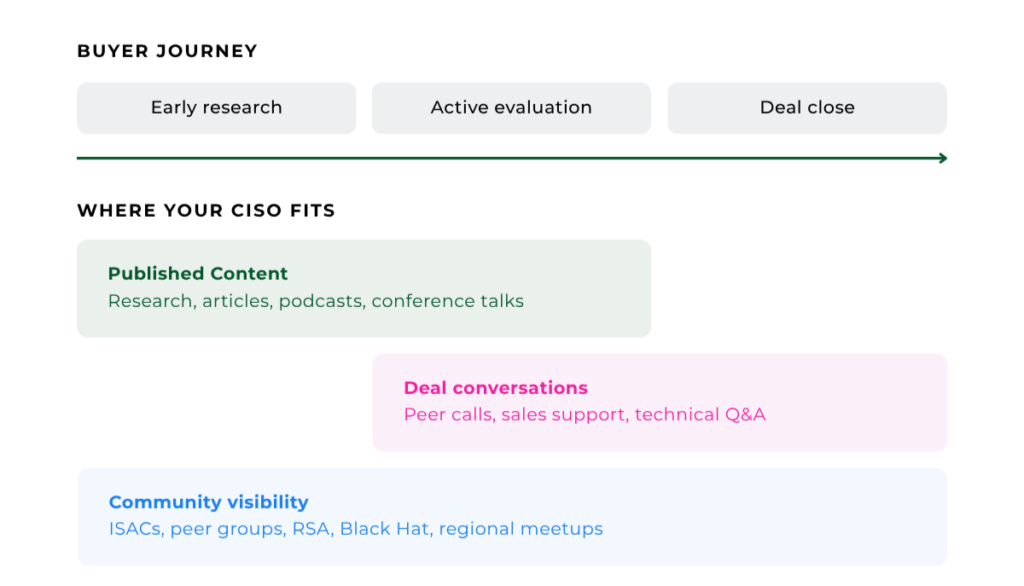
Put Your Expertise In Writing
This is the “highest-leverage activity a CISO can participate in,” as Liz Farquhar puts it. CISOs have specific, experience-backed perspectives on compliance trends and how security should factor into software and hardware purchasing decisions. That knowledge, when published, does work that no amount of marketing polish can replicate.
CISOs’ thought leadership content can be published through research reports, keynote speeches, social media posts, and podcasts. What matters is that the perspective comes from a practitioner, not from a marketing team.
Microsoft runs a podcast series where their CISO, Bret Arsenault, has peer-to-peer conversations with other security leaders. James Azar, CISO at Artera Services, hosts the podcast CISO Talk, covering operational security topics for a practitioner audience. And Joel Fulton, CISO at Cyderes, published a LinkedIn article breaking down how Claude Mythos could influence threat detection and what that means for cyber organizations adapting their defenses.
Show Up in Deal Conversations and Arm Your Sales Team
You don’t need to join every sales call. But when a buyer’s security team wants to talk to a peer before signing, being available for that conversation removes friction your sales team can’t remove on their own.
Beyond live conversations, CISOs can also help with creating sales assets. Every B2B SaaS company needs trust-building assets that address security concerns throughout the buyer journey. These materials close the distance between what your sales team can articulate and what a buyer’s security team needs to hear.
Be Visible in the Communities Your Buyers Already Belong To
CISOs already have professional networks: ISACs, CISO peer groups, conferences like RSA and Black Hat, regional security meetups, and online communities where practitioners compare notes. The demand gen value of these spaces is that your buyers are in them, forming opinions about vendors long before they start a formal evaluation.
Showing up matters more than presenting. Answering a question in a peer forum, participating in a panel, or joining a roundtable discussion puts your name and your company’s name in front of buyers in a context where they’re receptive. These professional spaces are where security leaders talk to each other, and that’s exactly why the exposure is worth more than a sponsored webinar.
Your marketing team can help by identifying which events and communities have the highest concentration of your target buyers and by making sure your company’s presence at those events is coordinated with broader demand gen campaigns. But the conversations themselves have to come from you.
The Realistic Version of CISO Involvement in Demand Generation
None of this requires a CISO to become a part-time marketer. The most effective version is selective and structured: a quarterly research contribution and a few sales calls when the buyer’s security team needs a peer, plus visibility at the conferences you’re already attending.
Most cybersecurity companies don’t have a system for capturing what their CISO knows and turning it into content, sales assets, and event strategy that feeds demand gen. That’s an operational problem, and it’s one a marketing team with the right partner can solve.
If this resonated, send it to your head of marketing or your CMO. The demand gen system that captures what you know and puts it to work is their problem to build, but they need to know you’re willing to be part of it.
And if your team is looking for a partner who understands how to turn practitioner expertise into demand generation, point them to Method Q. We would love to hear what you’re working on.